
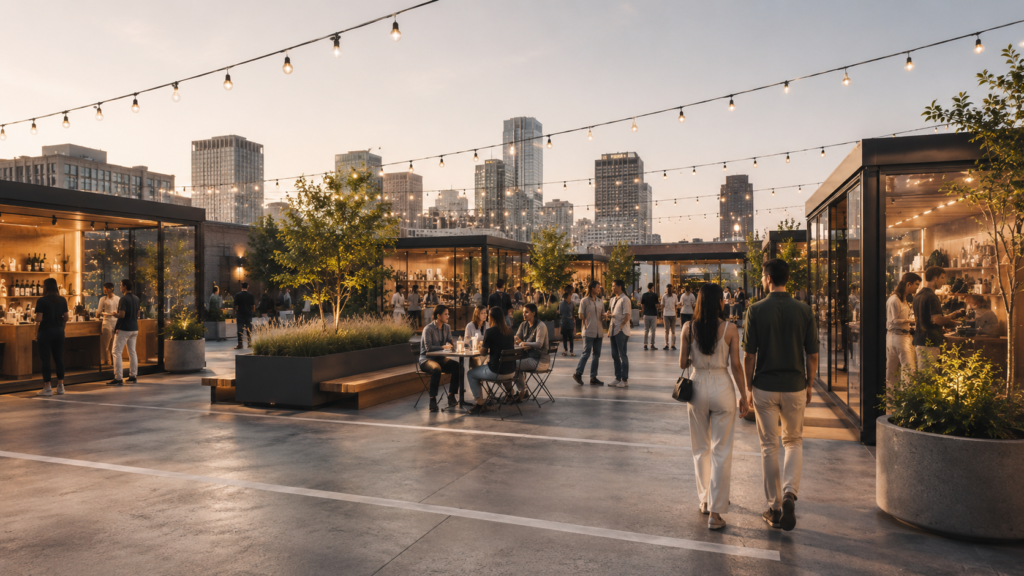
Modern brands are built for speed. They launch products quickly, test creative constantly, respond to communities in real time, and adjust their strategies based on what customers are doing now. Their marketing calendars can change by the month. Their product stories can change by the season. Their audiences can form around a collaboration, a creator, a drop, or a cultural moment almost overnight.
Traditional retail real estate was not built for that pace. It was designed around fixed locations, long leases, construction timelines, custom buildouts, and a high degree of permanence. That model works for many established retailers, but it is poorly matched to brands that need to experiment before they commit.
The result is a gap. Brands want physical presence, but the infrastructure available to them often assumes a level of certainty they may not have. Retail needs an infrastructure upgrade.
The mismatch between brand speed and real estate rigidity
The friction is not hard to understand. A brand may want to test a city, support a launch, activate around an event, or create a seasonal experience. But the available options can be limited. A permanent lease may be too much. A one-off pop-up buildout may be inefficient. Temporary spaces can be inconsistent, improvised, or difficult to replicate across markets.
This creates a strange outcome: the brands most in need of flexible physical retail often face the most complicated path to using it. They may have demand, creativity, and customer interest, but not the time or budget to reinvent a physical environment every time they want to show up.
A better system would make physical retail more repeatable. It would allow brands to deploy environments without treating each activation as a bespoke construction project. It would separate the value of the brand experience from the waste and delay of rebuilding from zero.
What modular infrastructure changes
Modular retail infrastructure changes the starting point. Instead of asking, “What do we need to build from scratch?” a brand can ask, “How do we adapt the platform for this experience?” The physical structure becomes reusable. The environment can be configured, branded, refreshed, and redeployed. The emphasis shifts from permanent construction to flexible activation.
That matters because the physical needs of brands are not always permanent, even when the brand itself is serious. A brand might need a presence in one city for a product launch, another for a partnership, and another for holiday traffic. It might need to learn which market deserves a deeper investment. It might need to create a physical expression of a campaign for a limited window. Modular infrastructure supports those needs without forcing every deployment into the same long-term real estate model.
The infrastructure becomes an enabling layer. It lets brands do more with physical retail because the baseline system is already in place.
From one-off pop-ups to a repeatable platform
The phrase “pop-up” often describes the visible result: a temporary store or activation. But the more important question is what sits underneath it. Is it a one-off project, or is it part of a repeatable platform?
A one-off pop-up can be useful, but it has limits. Each deployment may require a new space, new buildout, new approvals, new logistics, and new problem-solving. A platform approach creates continuity. It allows knowledge, materials, design decisions, operational practices, and brand components to carry forward from one deployment to the next.
That repeatability is what makes flexible retail scalable. Without it, short-term retail can remain fragmented. With it, short-term retail can become a legitimate physical expansion strategy.
Why this matters for Popular
Popular is focused on the infrastructure layer of flexible retail. The goal is not simply to place temporary stores. The goal is to make short-term physical retail easier to deploy, easier to repeat, and easier to adapt across different locations and brand needs.
By using modular, reusable environments, Popular gives brands and property owners a shared system. Brands get a path into physical retail without committing to a permanent store. Property owners get a way to activate space without waiting for traditional redevelopment. The infrastructure sits between them as the mechanism that makes the model work.
Closing thought
Retail has changed faster than the physical systems that support it. Brands now need retail environments that can test, move, respond, and evolve. The next phase of retail innovation may not be defined only by what appears inside the store. It may be defined by the infrastructure that makes the store possible in the first place.
Interested in using flexible retail to test a market, activate a property, or build a temporary brand destination? Contact Popular to explore what a modular retail deployment could look like.