
For a long time, physical retail was evaluated through a narrow lens: sales, rent, labor, inventory, and profit. Those measures still matter. A store that cannot sell eventually has a problem. But for modern brands, especially those still learning how and where to expand, the value of a physical store can extend well beyond the register.
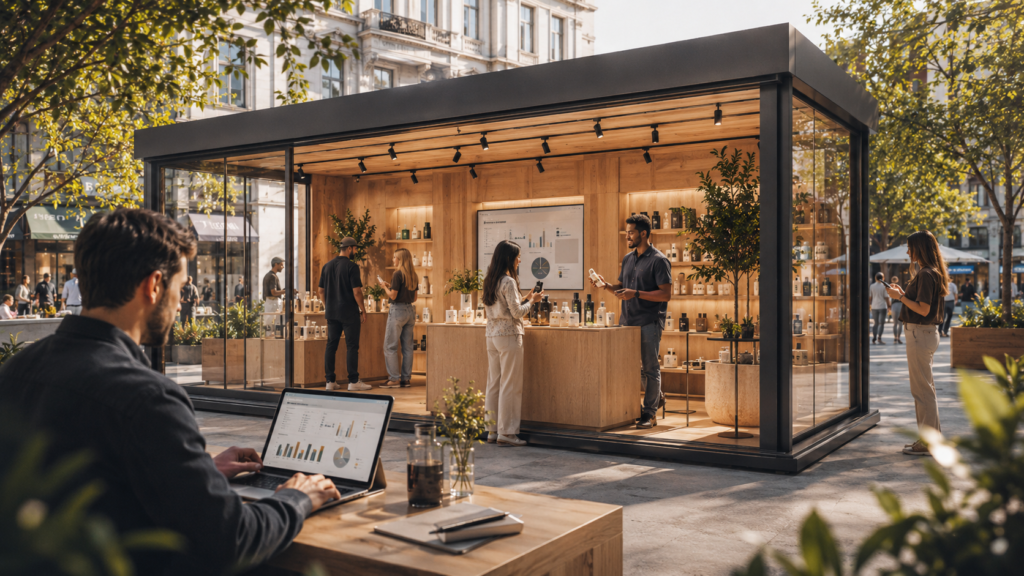
A short-term store can behave like a data channel. It can reveal what customers notice first, what they pick up, what they ask, what they misunderstand, what they compare, what they buy, and what they leave behind. It can show whether a brand has local awareness, whether products need education, whether pricing feels intuitive, and whether online demand translates into physical behavior.
In an omnichannel world, the store is no longer only an endpoint for transactions. It is a source of intelligence.
The limits of online-only signals
Digital data is powerful, but it is incomplete. Online behavior can show clicks, conversions, abandoned carts, repeat purchases, and geographic demand. It can tell a brand where customers are shipping products and which campaigns are generating traffic. But it cannot fully explain what happens when a customer encounters the brand in person.
Some products need to be touched. Some brands need to be explained. Some customers need to compare sizes, materials, textures, fit, or quality before they understand the value. Some categories benefit from conversation. Others benefit from the emotional effect of seeing the brand in a physical setting.
A temporary store gives brands access to those offline signals without requiring a permanent location. It adds a missing layer to the customer picture.
What the physical world can teach
The learning from short-term retail can be surprisingly broad. A brand can study product response: which items attract attention, which convert, which need more explanation, and which create repeat questions. It can study merchandising: how customers move through the space, where they pause, what they miss, and how different displays change behavior.
It can also study geography. A strong online customer base in a region may or may not translate into walk-in demand. A neighborhood with lower existing awareness may still perform well if the location has the right traffic and neighboring uses. A market that seems promising on paper may reveal that the brand needs a different format, assortment, or event strategy.
These insights can guide far more than the temporary store itself. They can influence future store decisions, wholesale strategy, product development, local marketing, staffing, customer education, and even the design of the brand’s digital experience.
Rethinking store performance
If a short-term store is treated only as a miniature permanent store, it may be judged too narrowly. Sales per square foot is useful, but it does not capture the full value of learning. A brand might operate an activation that produces moderate sales but generates exceptional insight into a new market. Another might discover that a product line has strong in-person appeal and deserves more investment. Another might learn that its online messaging does not match how customers describe the product face to face.
That does not mean financial discipline should disappear. It means the purpose of the store should be defined before the doors open. Is the goal revenue, awareness, market validation, product education, customer acquisition, community building, content creation, or a combination of those outcomes? The measurement should match the mission.
A short-term retail program becomes more valuable when brands are clear about what they are trying to learn.
The feedback loop between physical and digital
The most interesting omnichannel strategies do not treat digital and physical as separate worlds. A temporary store can improve digital performance by clarifying product messaging, generating content, capturing customer questions, and strengthening local awareness. Digital channels can support the physical store by driving appointments, promoting events, collecting leads, and extending the life of the activation after it closes.
The store becomes a feedback loop. Customers encounter the brand physically, the brand learns from those interactions, and those lessons inform the broader business. For emerging brands, that loop can be especially valuable because it turns physical retail from a risk into a learning system.
Why this matters for Popular
Popular gives brands a way to use physical retail as a repeatable learning channel. Because deployments can be short-term and modular, brands can test different markets, moments, and formats without making each decision permanent. That makes the store more than a place to sell. It becomes a tool for understanding what the brand should do next.
For property owners, this also creates value. A location that helps brands learn becomes more than available space. It becomes part of a discovery network for physical retail demand.
Closing thought
The future of retail will not be measured only by the divide between online and offline. It will be shaped by how well brands learn across both. A short-term store can capture something that digital dashboards alone cannot: the reality of customers encountering a brand in the physical world. For brands willing to listen, that may be the most valuable data point of all.
Interested in using flexible retail to test a market, activate a property, or build a temporary brand destination? Contact Popular to explore what a modular retail deployment could look like.