
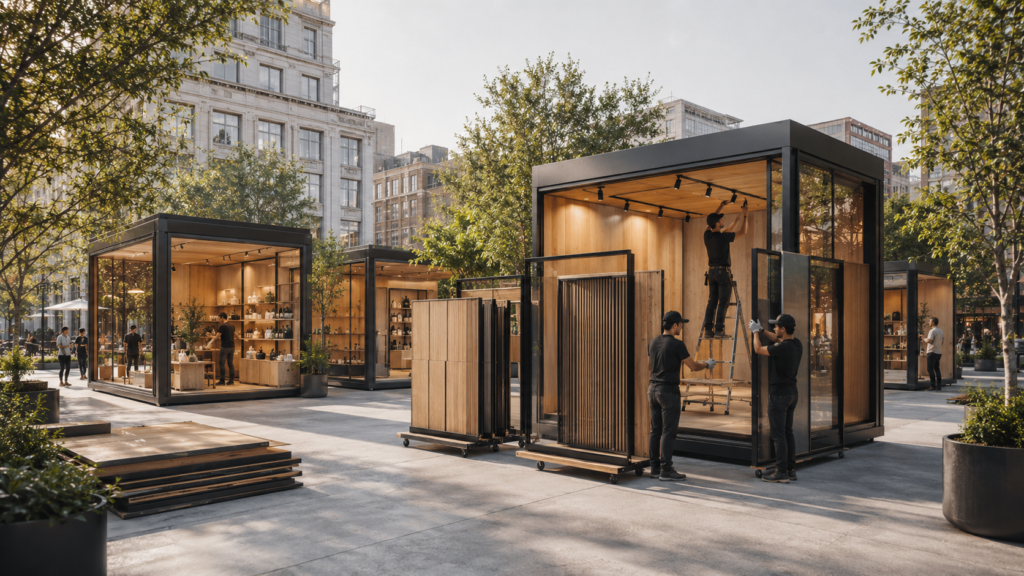
Every property has a story it is telling. Sometimes that story is obvious: a busy entrance, a well-tenanted storefront, a lively pedestrian corridor. Other times, the story is quieter: empty pavement, unused land, a dark corner of a parking area, a section of a center that no longer pulls the way it once did.
For property owners, the challenge is not simply that these spaces are underutilized. It is that the traditional tools for activating them are often too slow, too expensive, or too permanent. Ground-up development can take years. Conventional leasing depends on tenants that may not fit the space or the moment. Major redevelopment requires capital, approvals, and patience. Meanwhile, the property continues to miss opportunities for traffic, revenue, and relevance.
Flexible retail offers a different playbook. Instead of waiting for a permanent answer, owners can create a temporary but intentional destination. The goal is not to disguise vacancy. The goal is to convert inactive space into a programmed environment with a reason for people to visit.
The hidden value of overlooked space
Underutilized space is often treated as a problem to be solved later. But in many cases, it already has useful attributes: visibility, access, parking, proximity to existing customers, or adjacency to complementary uses. The issue is that the space does not fit neatly into the conventional leasing box.
A parking deck, a paved pad, a vacant parcel, or an inactive plaza may not be ready for a traditional building. But it may be ready for a modular retail environment. It may be ready for a rotating mix of brands, food concepts, product launches, seasonal merchants, local operators, or national activations. It may be ready to become part of the customer experience instead of sitting at the edge of it.
This is where temporary can become strategic. A flexible retail activation can give an owner a way to test demand, animate the property, and create momentum without making a permanent construction decision too early.
Activation is more than occupancy
In traditional real estate language, success is often measured by occupancy. Space is either leased or it is not. But property activation requires a broader lens. An activated property has movement, energy, programming, and a reason for people to return. It creates the feeling that something is happening.
A short-term retail district can contribute to that feeling. It can bring in brands that would not otherwise sign a long lease. It can create limited-time moments that encourage urgency. It can support events, launches, local collaborations, and community programming. It can also make a property feel more current, more curated, and more responsive to what consumers actually want to experience.
That matters because traffic is not only a function of square footage. It is a function of interest. People go where there is something to discover.
A bridge between today and the next major plan
Many owners have long-term visions for their properties. They may be studying redevelopment, repositioning a center, evaluating mixed-use options, or waiting for market conditions to clarify. Flexible retail does not have to compete with those long-term plans. It can bridge the gap.
A temporary retail environment can generate revenue while a larger strategy develops. It can demonstrate demand to partners, tenants, municipalities, or investors. It can show which customer segments respond to the site. It can also provide a visible signal that the property is being actively managed, not passively held.
In some cases, the activation itself may inform the permanent plan. The owner may learn which categories draw people, which events perform, which locations on the property feel most natural, or which brands deserve a deeper relationship.
Why this matters for Popular
Popular is designed for property owners who see potential in spaces that traditional retail formats overlook. Its modular retail environments can be placed, programmed, and refreshed without requiring a conventional buildout. That gives owners a way to create an active destination using infrastructure that is meant to move, adapt, and be reused.
The result is not a one-off pop-up. It is a repeatable activation model. A property can host a changing mix of brands and experiences while retaining the ability to evolve over time. For owners, that means underutilized space can become a platform rather than a liability.
Closing thought
The strongest properties are not always the ones with the most square footage. They are the ones with the clearest reason to visit. Flexible retail gives owners a way to create that reason in places that might otherwise sit quiet. Empty space is not just empty. With the right model, it can become the beginning of a destination.
Interested in using flexible retail to test a market, activate a property, or build a temporary brand destination? Contact Popular to explore what a modular retail deployment could look like.