
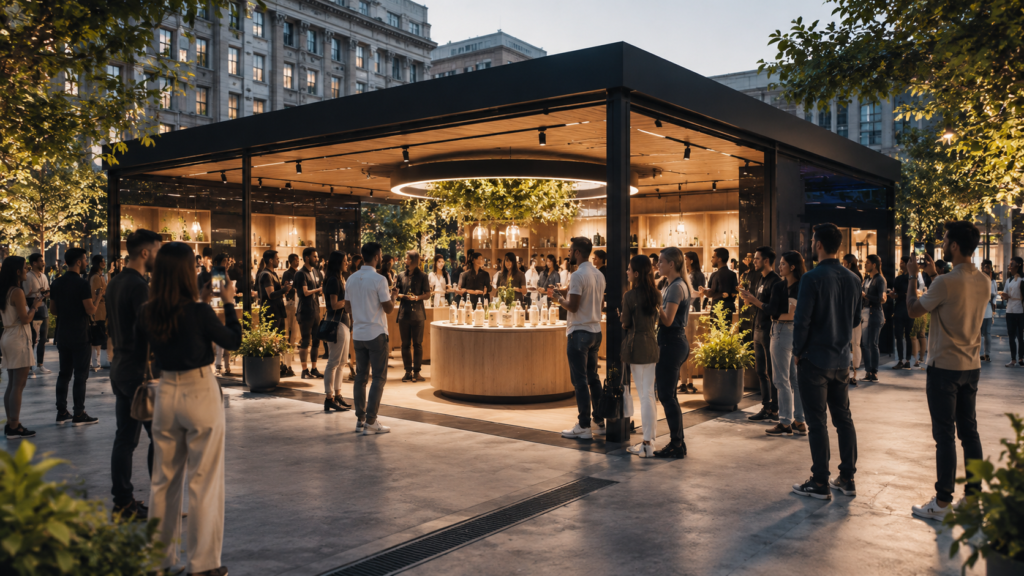
A store used to be defined primarily by inventory. It was where products were displayed, purchased, and taken home. That role still matters, but it is no longer enough to explain the most interesting parts of physical retail. Increasingly, the most effective brand environments behave less like static stores and more like live moments.
They have timing. They have a reason to exist now. They invite participation. They create content, conversation, and urgency. They may be built around a product launch, a collaboration, a film release, a championship, a new collection, a founder appearance, a limited-edition drop, or a seasonal ritual. In these cases, the physical environment is not simply a channel. It is the stage.
That shift is one of the reasons short-term retail is becoming more important. A temporary store can be designed around a moment in a way a permanent store often cannot. It can be more focused, more theatrical, and more responsive to culture.
Digital attention is crowded
Brands have more ways than ever to reach customers, but attention online is difficult to hold. A campaign can be seen and forgotten in seconds. A launch can disappear into the feed. Even strong creative has to compete with everything else a customer is scrolling past.
Physical space changes the equation. When someone enters a branded environment, the brand has their attention in a deeper way. The customer can touch the product, talk to a person, take a photo, join an event, hear the story, and feel the atmosphere. The experience becomes harder to ignore because it is not only seen. It is inhabited.
This does not make digital irrelevant. The best physical activations often amplify digital reach. But the center of gravity changes. The brand is no longer asking customers to imagine the experience. It is giving them a place to step into it.
The store as a temporary world
The most compelling short-term retail concepts are not merely smaller stores with shorter leases. They are temporary worlds. A running brand might build a community hub around a race weekend. A beauty brand might create an education-driven studio around a new product line. A home brand might create a tactile showroom where customers can feel scale, texture, and material in person. An entertainment brand might create a destination around a release window, giving fans a place to gather and participate.
In each case, the space works because it is specific. It has a theme, a timeframe, and a reason to visit. The temporary nature is not a weakness. It is part of the appeal. Customers understand that the experience will not be there forever, and that creates urgency without needing to manufacture it.
A permanent store is expected to be useful every day. A short-term activation can be memorable because it is built for a defined moment.
Experiences that sell after the visit
The value of an experiential retail activation does not end when a customer leaves. A well-designed environment can create photos, videos, word of mouth, press interest, customer feedback, and stronger brand recall. It can give sales teams and marketing teams a new story to tell. It can provide a place for creators, partners, and local communities to interact with the brand in a more substantial way.
This is one reason the old distinction between marketing and retail is becoming less useful. A short-term store can sell product, but it can also launch a campaign, educate customers, build loyalty, create content, and test a new audience. The same environment can serve multiple functions at once.
For brands, that makes the physical activation more than a cost center. It becomes an asset that can generate attention, learning, and commercial activity at the same time.
Why this matters for Popular
Popular is built around the idea that brands need physical environments that can move at the speed of moments. A product launch does not wait for a traditional lease cycle. A cultural event does not last long enough to justify a permanent buildout. A collaboration may need a space for weeks, not years.
By using modular, reusable retail infrastructure, Popular gives brands a way to create temporary physical destinations without starting from scratch each time. The brand experience can be designed, deployed, refreshed, and moved. That makes physical retail more compatible with campaigns, communities, and cultural timing.
Closing thought
The future of brand activation will not be limited to ads, websites, or permanent stores. It will include physical places that appear when the moment calls for them and disappear when the moment has passed. The best brand experiences are beginning to look more like events because customers want more than access. They want something to remember.
Interested in using flexible retail to test a market, activate a property, or build a temporary brand destination? Contact Popular to explore what a modular retail deployment could look like.