
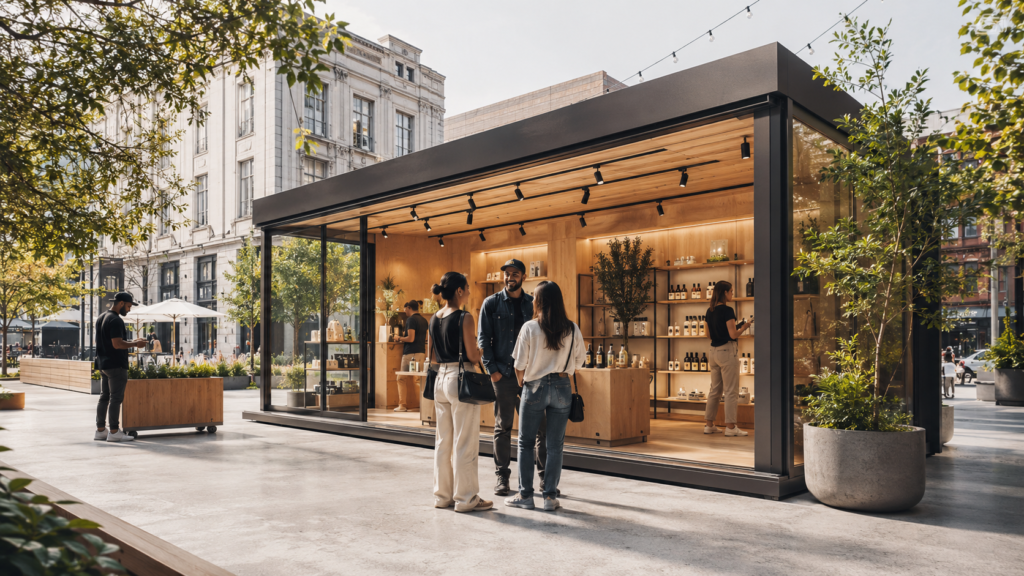
For a growing brand, the idea of opening a first store carries a certain romance. It suggests permanence, credibility, and arrival. The brand has moved from the feed into the street. It has a door, a sign, a sales floor, and a place where customers can experience it in person.
But a first store can also be a trap. A lease is not just a marketing decision. It is a multi-year operating commitment. It brings buildout costs, staffing requirements, inventory risk, local market assumptions, and a long list of fixed obligations that do not disappear if the market turns out to be weaker than expected.
For digitally native brands, emerging consumer companies, and category challengers, the better question may not be: When should we open a store? The better question is: What would we need to learn before a store deserves to exist?
The Old Model: Commit First, Learn Later
Traditional retail expansion often asks brands to make major commitments before they have enough physical-world evidence. A team studies demographics, online order data, mall traffic, competitive maps, and real estate options. They choose a site, negotiate a lease, design the store, invest in construction, hire staff, and launch.
Only then do they learn the most important things: who actually walks in, which products work in that market, what price points feel right, how customers respond to the brand in person, and whether the location creates enough repeat engagement to justify the expense.
That sequence made more sense when retail expansion was slower, brands were built around permanent locations, and the store was often the primary customer channel. It fits less comfortably in a world where brands learn quickly, test constantly, and build audiences before they build storefronts.
A Store Can Be a Test Before It Becomes a Commitment
Short-term retail changes the order of operations. Instead of using a permanent store to discover whether a market works, a brand can use a temporary store to determine whether a permanent store is warranted.
A 60-day retail test can answer questions that no spreadsheet can fully resolve. Do customers understand the product without a screen explaining it? Does the brand attract casual foot traffic or only existing fans? Which products become conversation starters? Does the local customer look like the brand expected? How much education does the sale require? What time of day is strongest? What adjacencies help or hurt?
The value is not limited to revenue. The store becomes a research environment, merchandising lab, local marketing test, and customer conversation engine. It can reveal where the brand has real-world pull and where online demand may be misleading.
Physical Retail Should Have a Learning Curve
Brands already test digital creative, pricing, email subject lines, landing pages, and product positioning. They rarely expect the first version of a campaign to be the final version. Yet physical retail is often treated as if the first big commitment has to be right.
That is an unnecessary mismatch. If a brand can test online before scaling spend, it should be able to test physically before scaling real estate. The first store does not need to be a polished monument to certainty. It can be a structured learning exercise.
This approach also makes the brand more disciplined. A short-term store forces clear hypotheses: Why this market? Why this product mix? What would success look like? What would we need to observe before extending, relocating, or investing in a permanent location?
The First Store Should Be Earned
There is still a place for permanent retail. A flagship can be powerful. A long-term neighborhood store can become part of a customer’s routine. A strong physical footprint can deepen trust and strengthen the entire brand.
But permanence should be the result of evidence, not the starting point. The most thoughtful brands will treat their first physical step as a way to earn the next one. They will test, learn, refine, and then commit where the signal is strongest.
That creates a healthier expansion model. Brands avoid locking themselves into the wrong markets too soon. Landlords get tenants with better evidence behind their plans. Customers get stores that feel more relevant because the brand has actually learned from them.
Where Popular Fits
Popular exists for this middle ground between online traction and permanent real estate. It gives brands a physical format that is real enough to learn from, but flexible enough to avoid turning every experiment into a long-term lease.
A Popular deployment can help a brand test a market, refine a product story, gather customer feedback, and understand what a future store should become. It makes physical retail less like a leap of faith and more like a staged expansion strategy.
The flagship may still come. But the smarter path is to earn it first.