
For years, the retail expansion playbook was built around conviction. A brand identified a promising market, signed a lease, invested in design and construction, hired staff, stocked the shelves, and hoped that the assumptions behind the decision were right. The store either worked or it did not. By the time the market gave its answer, the brand had already made a long-term commitment.
That model still has a place. Permanent stores matter. They can anchor a brand, serve loyal customers, and create a presence that no digital channel can fully replace. But for many emerging and digitally native brands, the traditional leap into physical retail can feel disproportionate to the question they are trying to answer. They may not yet be asking, “Should we open here for the next five years?” They may be asking, “Is there enough demand here to justify deeper investment?”
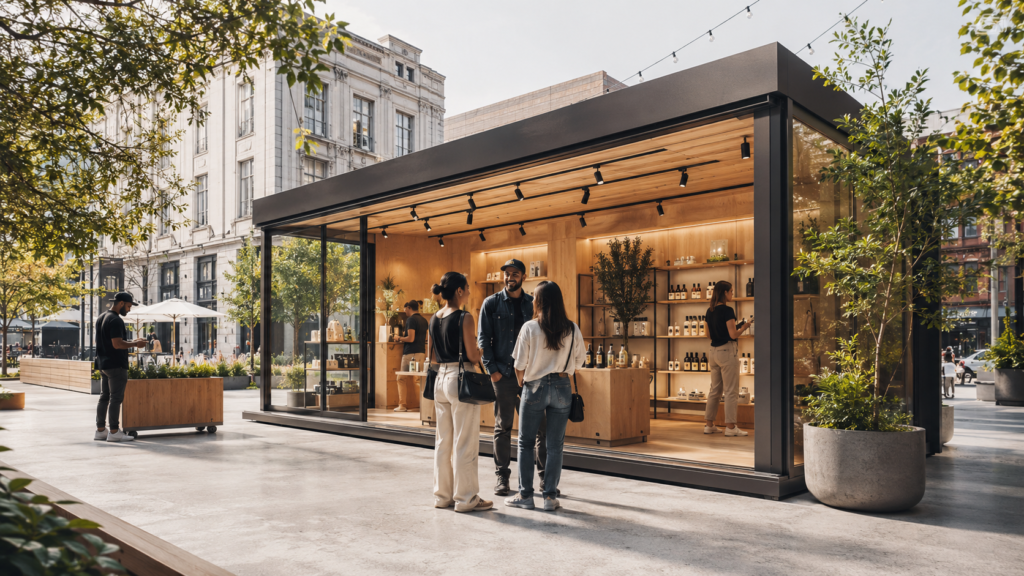
That is where the 60-day store becomes powerful. A short-term retail environment allows a brand to treat physical retail as a testable format rather than a permanent bet. The store becomes a live market study: real customers, real products, real conversations, real sales behavior, and real learning.
The problem with guessing where to grow
Online data can tell a brand where customers browse, click, and buy. It can show concentrations of existing customers, shipping destinations, and regional interest. But online behavior does not always translate cleanly into physical retail behavior. A customer who buys a hoodie online may respond differently when they can touch the fabric, compare colors in person, or speak with someone who understands the brand story.
A physical store reveals a different layer of demand. It shows whether people will walk in when they are not already searching for the brand. It shows which products stop customers in their tracks. It shows whether the brand can generate attention in a specific neighborhood, shopping district, campus, entertainment corridor, or mixed-use property.
Most importantly, it shows these things before the brand has locked itself into a conventional store commitment.
What a short-term store can actually test
A 60-day store is not just a smaller version of a permanent store. It can be designed around a specific learning objective. One brand may use it to understand whether a market is ready for a permanent location. Another may use it to test a new product line, a seasonal assortment, or a different price architecture. A third may use it to compare how customers respond to its brand in person versus online.
The questions can be practical: Which products convert best? What questions do customers ask most often? How much staff education is required? What merchandising layout drives the cleanest customer journey? Which neighboring tenants or events improve traffic? Which hours matter? Which products need to be seen in person to be understood?
The answers are not abstract. They come from the daily reality of operating a physical environment. Sales matter, but they are not the only signal. Customer feedback, dwell time, repeat visits, event attendance, product trial, local partnerships, and the quality of conversations all help shape the brand’s next move.
Lowering the cost of being wrong
The value of short-term retail is not that every test succeeds. The value is that the cost of being wrong becomes manageable. A brand may learn that a neighborhood has strong awareness but weak conversion. It may learn that a product looks better online than it sells in person. It may learn that a city has passionate fans but not enough traffic in the chosen location. Those are not failures if they prevent a larger mistake.
In that sense, flexible retail makes physical expansion more disciplined. It gives brands permission to explore without pretending every exploration needs to become a permanent store. It turns uncertainty into a process.
Why this matters for Popular
Popular exists for this shift in retail thinking. Instead of asking brands to choose between staying online or committing to permanent space, Popular creates a middle path: modular, reusable retail environments that can be deployed for defined windows of time. A brand can show up physically, learn from the market, and carry those insights into its next decision.
For a brand considering physical retail, the first store does not need to be a forever store. It can be a question posed to the market. Popular helps make that question easier to ask, easier to measure, and easier to repeat.
Closing thought
The next great retail expansion may not begin with a grand opening in the traditional sense. It may begin with a focused, temporary deployment that tells a brand where it belongs, who it serves, and what kind of physical presence it should build next. In a faster retail environment, the smartest store may be the one designed to teach before it commits.
Interested in using flexible retail to test a market, activate a property, or build a temporary brand destination? Contact Popular to explore what a modular retail deployment could look like.